


Audi is consistently rolling out artificial intelligence (AI) in production and logistics: the company is scaling up its own cloud platform for production and introducing new AI use cases and technologies for large-scale series production
“Artificial intelligence is a quantum leap for efficiency in our production. With our AI and digitalisation roadmap, we are transforming our plants into smart factories where AI acts as a partner, providing our employees with tailored support. The first AI-controlled robots are taking over tasks that are ergonomically strenuous, and chatbots are providing additional relief,” explains Gerd Walker, Member of the Board of Management for Production and Logistics at Audi. “
Edge Cloud 4 Production forms the foundation
Audi is putting the Edge Cloud 4 Production (EC4P) into operation across its production environment. EC4P makes it possible to combine conventional automation technology with flexibility and computing power from the cloud. This allows Audi to simplify processes, reduce the amount of hardware required on site, and introduce new functions more quickly.
In vehicle assembly at German plants, for example, worker guidance is increasingly being controlled centrally from the cloud: employees on the production line receive information such as vehicles’ specifications or regional versions from a central source in real time. The move to the cloud has already eliminated the need for more than 1,000 industrial PCs.
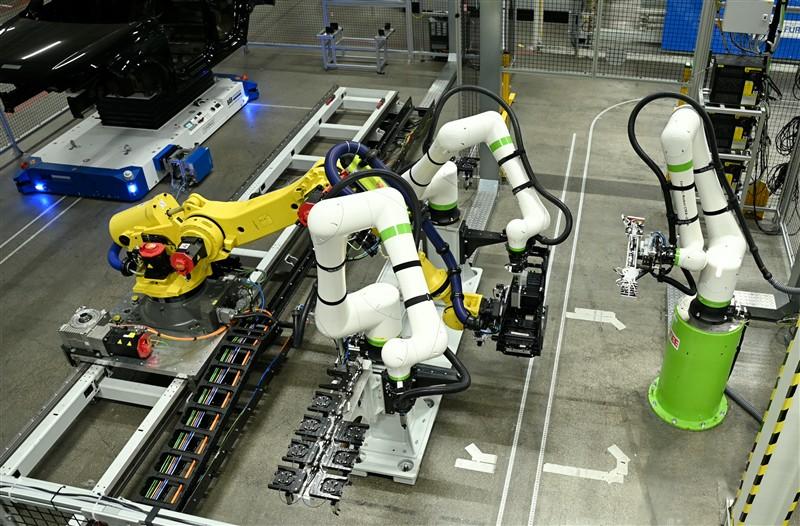
In the body shop for the A5 and A6 series in Neckarsulm, Germany, EC4P is now being used in a highly automated production environment for large-scale series production for the first time. Virtual programmable logic controllers (vPLC) are replacing local hardware controllers on the production lines. Industrial devices, including around 100 robots, work together via the EC4P with millisecond precision.
AI supports employees and ensures quality
The Weld Splatter Detection (WSD) system will also run on the EC4P in the future, enabling even greater flexibility and scalability. At Audi’s Neckarsulm site, WSD detects weld splatter on the underbody of a car body and marks it with light. Thanks to a recent upgrade, a robot arm has taken over grinding them down – a physically demanding job. The Volkswagen Group’s first AI-supported weld spatter detection system will soon go into series production at six plants in Ingolstadt.
Audi is also developing ProcessGuardAIn, its own AI solution for monitoring manufacturing processes. This was made possible by a team of Audi data experts who have built up the cross-plant “P-Data Engine” platform over the past few years. The platform combines various system and plant data from production at a uniform quality level. Thanks to this database, data scientists at Audi can quickly and efficiently develop and scale AI applications – such as ProcessGuardAIn. The AI solution bundles decades of expert knowledge as well as plant and process data in a standardised, scalable modular system that can be used across the Volkswagen Group.
Based on machine and sensor data, ProcessGuardAIn already monitors production steps in real time, detects anomalies at an early stage, and informs the experts. The pilot phase for two use cases is currently ongoing at the Neckarsulm paint shop: dosage optimisation in pretreatment and anomaly detection in cathodic dip coating (CDC). Introduction into series production is planned for the second quarter of 2026.
Unique, forward-looking project: automated wiring loom installation
In the Next2OEM project, Audi is working with ten partners at its Ingolstadt, Germany, headquarters to demonstrate how the production and assembly of a wiring loom can be completely digitised and automated – from the supplier to installation in the factory. To date, less than ten percent of wiring loom production and assembly is automated across the industry.
A demonstrator funded by the Federal Ministry for Economic Affairs and Energy has been created in Ingolstadt that maps the entire process chain: from wiring loom production and pre-assembly in the centre console with automation-compatible connectors to automated installation in the vehicle – controlled by a central system. The benefits for Audi are considerable: less logistical effort and significantly shorter lead times for changes – minutes instead of weeks. The next step is to incorporate the knowledge gained into the large-scale production of future vehicle projects.
First IPAI cooperation: AI-based dryer operation in the paint shop
Audi is testing the first application from an IPAI cooperation in series production at its Neckarsulm site with AI-supported dryer operation. The AI model on which the application is based comes from another industry. Through cooperation and exchange within the IPAI, experts have identified the potential for Audi. Various controllers that regulate the temperature and air volume in the longitudinal dryer are currently being connected to the AI system. This allows for a faster response to even the smallest changes in production line speed to make the drying process as resource-efficient as possible. Audi will be testing how much energy can be saved as a result until summer 2026.