


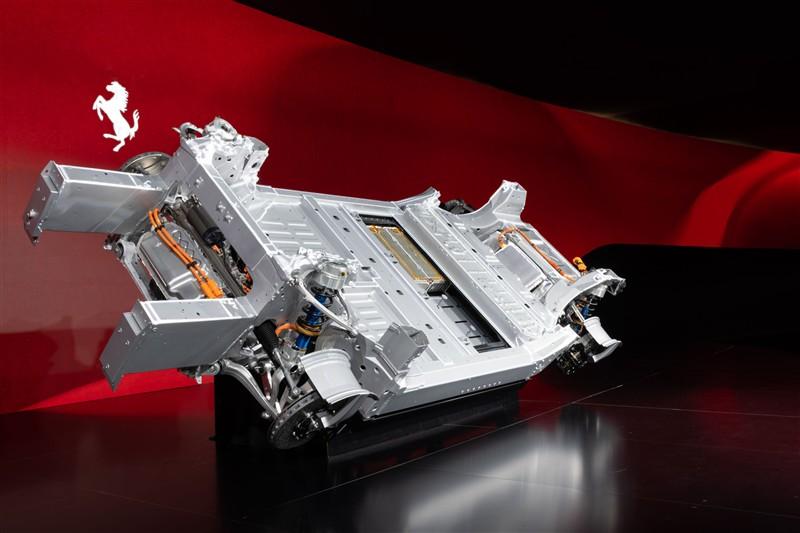
Ferrari has reveaedl the production-ready chassis and components of its new electric car, the first full-electric model in the history of the Prancing Horse.
The new Ferrari Elettrica combines state of the art technology with superlative performance and the extraordinary driving pleasure that distinguishes every Ferrari model.
This car can be considered the culmination of a long journey of technological research into electrification that began with the first hybrid solutions derived from the 2009 Formula 1 car.
The strategy leading Ferrari towards the first electric model in its history was clear from the outset: that a model such as this would only be introduced once the technology available could ensure the superlative performance and authentic driving experience befitting the values of the brand. For the first time, both the chassis and bodyshell are manufactured with 75 percent recycled aluminium.
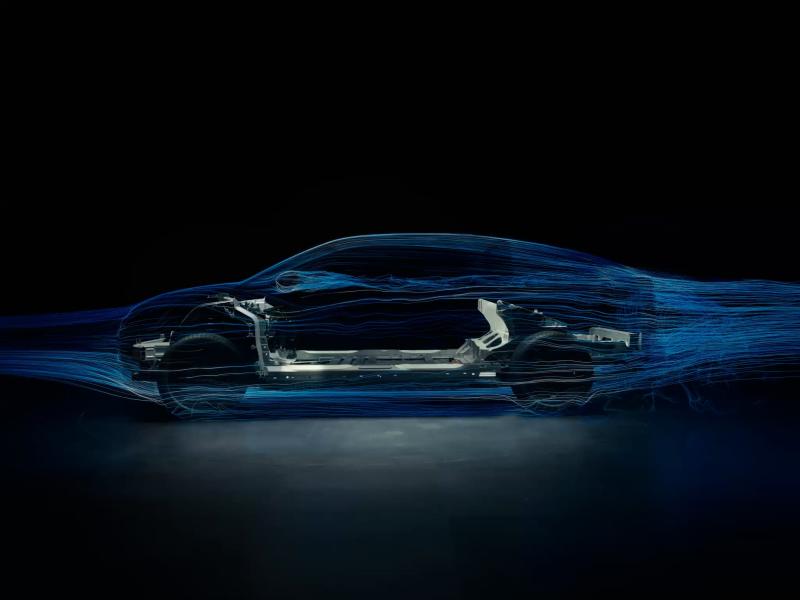
The architecture features short overhangs, an advanced driving position close to the front axle, and a battery integrated completely into the floorpan. The modules are installed between the front and rear axles, with 85 percent of them concentrated in the lowest position possible to lower the centre of gravity and benefit driving dynamics.
At the rear, Ferrari has introduced the first separate subframe in its history. It has been designed to reduce noise and vibration perceived in the cabin while still ensuring the stiffness and driving dynamics expected from a car from Maranello. The third generation of the 48 V active suspension system – takes ride comfort, body control and vehicle dynamics to even greater heights by distributing cornering forces optimally over the four wheels.
The first all-electric Ferrari is equipped with two electric axles developed and built entirely in-house, each with a pair of synchronous permanent magnet engines and Halbach array rotors derived from F1 technology and industrialised for a series production application.
Designed and assembled in Maranello, the battery has an energy density of almost 195 Wh/kg – the highest of any electric car – and features a cooling system designed to optimise heat distribution and performance.
Chassis
The chassis of the new Ferrari Elettrica has an extremely short wheelbase. Inspiration for the architecture came from mid/rear-engined berlinetta models, with a driving position that places the driver near the front wheels to offer the purest dynamic feedback.
Opting for this layout brought significant engineering challenges, especially regarding energy absorption in the event of a crash, given the higher overall weight of an electric car. Ferrari chose an innovative solution: the front shock towers play a direct role in energy absorption during an impact, while the position of the front electric engines and inverter are designed to dissipate energy before it reaches the chassis nodes.
In the central part of the chassis, the battery is integrated completely into the chassis and situated under the floorpan of the car.
The performance objectives for the rear axle were clear from the start: we had to reduce rolling noise and powertrain vibration while maintaining the handling typical of a Ferrari and minimising any weight penalties this could bring.
The answer to these goals was to develop the first elasticised mechanical subframe in Ferrari history. The transmission of noise, vibration and harshness had to be reduced as much as possible to ensure on-board comfort.
This design choice led to a subframe of considerable size, which posed another challenge: keeping the weight of the system down. Inspiration for the solution came from the hollow chassis castings used on the rest of the chassis, and this technology was adapted for this new context. The result is the largest one-piece hollow casting ever produced by Ferrari.
The system connecting the subframe to the chassis allows the rear axle, suspension components and battery to be serviced independently, as they are encapsulated in a single, integrated load-bearing structure. Additionally, the active suspension system inverters are housed directly in the subframe.
E-axles
The front and rear axles comprise two independent electric engines each, which work in concert to enable torque vectoring and improve the car’s dynamic behaviour.
Every part of both the front and rear axles was developed entirely in-house by Ferrari to attain the extraordinary performance typical of the marque.
The front axle, with a total power output of 210 kW, can be decoupled at any speed (up to top speed) to transform the car to rear-wheel drive and maximise efficiency and consumption in driving situations where four-wheel drive isn’t needed. Under full acceleration, the axle can deliver up to 3500 Nm to the wheels.
The unparalleled lightness and compactness of the axle were made possible by integrating its components, and all the power electronics are installed directly on the axle. As well as reducing overall dimensions, this choice also improves efficiency and power density: the front axle achieves a power density of 3.23 kW/kg, and an efficiency of 93 percent at peak power output.
The outputs of the front and rear axles are asymmetric: the rear axle has a maximum power output of 620 kW, equating to a density of 4.8 kW/kg, and an efficiency of 93 percent at peak power output. The maximum rear torque transferrable to the tarmac is a staggering 8000 Nm in Performance Launch mode.
The front axle includes the disconnect system, which decouples the electric engines completely from the wheels to strike the ideal balance between efficiency and consumption. When dynamic conditions also call for traction from the front axle, the system automatically engages the two front engines and enables all-wheel drive.
Electric engines
The development of the permanent magnet synchronous engines equipping the axles pushed current technology to its limits. The motorsport heritage shows: the impressive torque and power density figures were achieved.
High rotational speeds – 25,500 rpm at the rear and 30,000 rpm at the front – allow these engines to deliver a peak power of 310 kW and 105 kW respectively, but with compact dimensions enabling a space-saving axle architecture. The rotor employs surface-mounted permanent magnets, segmented for higher efficiency, while the motorsports-derived Halbach array configuration directs the magnetic flux towards the stator to maximise torque density and reduce overall weight.
The stator, on the other hand, features ultra-thin (0.2 mm) non-oriented grain silicon-iron laminations, stacked with a self-bonding process to minimise the probability of short circuits between the individual laminations.
To improve heat transfer from the copper windings to the external cooling circuit, the stator is fully vacuum-impregnated with a high thermal conductivity resin offering a thermal conductivity 40 times higher than air.
The dynamic performance capabilities of these engines are astonishing: with a maximum angular acceleration of 45,000 rpm/s, the front engines spin up from stationary to maximum speed in under one second. This ensures that the system is not just powerful but also instantly responsive.
Battery
Designed and assembled completely in-house by Ferrari, the battery has been integrated into the floorpan, lowering the centre of gravity by 80 mm over an equivalent ICE model.
The layout of the cells is designed to minimise inertia and lower the centre of gravity, placing them where possible behind the driver seat. 85 percent of the weight of the modules is situated under the floorpan, while the remainder is located under the rear seat.
Sound
Rather than artificially replicate the timbre of an internal combustion engine, Ferrari chose to highlight the unique attributes of the electric drivetrain. The sound of the Ferrari Elettrica is not digitally generated, but is the direct and authentic expression of its components: a high-precision sensor installed on the rear axle picks up the frequencies of the powertrain, which are amplified and projected into the surroundings.
Active suspension
The architectural freedom offered by the electric powertrain, with its lower centre of gravity, paved the way for a considerable evolution in the active suspension system used on the Ferrari Purosangue and Ferrari’s latest supercar, the F80.
The most significate upgrade concerns the recirculating ball screw connected to the electric motor, the heart of the system. The screw has a 20 percent longer pitch and can better absorb and control vertical impact due to the smaller inertial forces transferred to the chassis of the car. The electric motor produces the same torque as in previous applications, and actively controls the forces exchanged between the chassis, tyre and road without forcing a trade-off between variable suspension stiffness and body control.
The shock absorbers feature a new optimised design that has reduced weight by two kg and now include an integrated thermocouple for monitoring and controlling lubrication oil temperature to ensure consistent behaviour in both hot and cold conditions.
Torque shift engagement
A sensation of constantly surging acceleration has always been a hallmark of Ferrari cars. The Ferrari Elettrica uses Torque Shift Engagement, a strategy that takes advantage of the optimised dimensional characteristics and instant response of the electric engines, to deliver an exciting and involving driving experience. Ferrari’s engineers have defined five levels of power and torque selectable sequentially from the right-hand shift paddle to deliver progressively stronger acceleration over a very broad range of speeds. The instantaneous response of the electric engines makes it possible to smooth out the transitions between one level and another so that the inevitable dip in torque is practically imperceptible, giving the driver the time to truly savour the resulting acceleration and offering the sensation of relentless thrust.
When braking, on the other hand, the left-hand paddle can be used to replicate the behaviour of a progressively more intense engine braking effect, calibrated specifically to offer an even more exciting driving experience.