


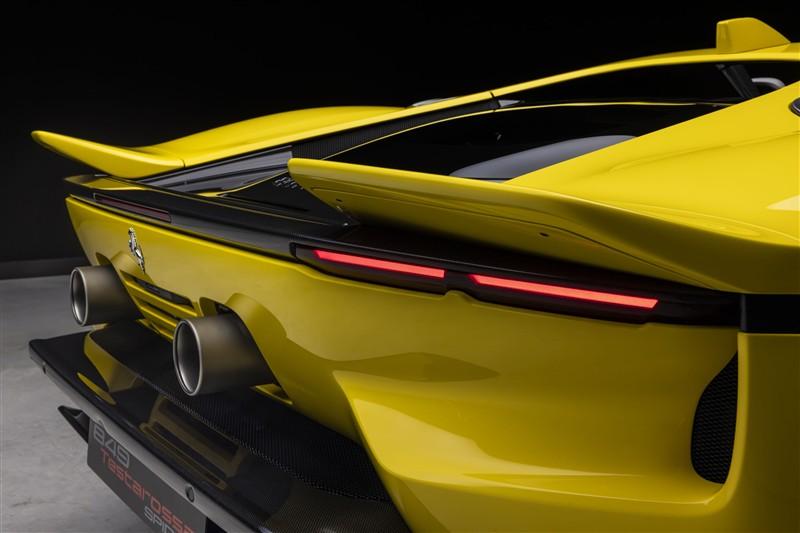
Ferrari has unveiled its latest sports car, the 849 Testarossa Spider. The car, which replaces the SF90 Spider in the range, is a hybrid plug-in super sports berlinetta equipped with three electric motors alongside the mid-rear twin-turbo V8, delivering a total of 1050 cv, 50 more than the car it replaces.
The car is both a true coupé and a true spider, thanks to Ferrari’s retractable hard top (RHT), which allows the driver to open and close the roof in just 14 seconds, even while driving at speeds up to 45 km/h.
The 849 Testarossa Spider takes its place at the top of Ferrari’s open-top sports car range thanks to its performance, its ability to thrill the driver without ever compromising ride comfort or interior refinement, as well as its futuristic yet deeply historically rooted design. It is also the reason for the return of a legendary name in Maranello’s history, Testa Rossa, which was first used on the 500 TR in 1956 to describe the colour of the cam covers of some of Ferrari’s most extreme, high-performance and iconic racing engines, before being used as a name for one of the marque’s most famous road-going models, the 1984 Testarossa.
Powertrain
The 849 Testarossa Spider is equipped with a plug-in hybrid (PHEV) system consisting of the 830 cv twin-turbo V8 engine combined with three electric motors, a high-voltage battery, and an inverter that together deliver a total output of 220 cv. This system brings the total power of the powertrain up to 1050 cv, an absolute record for a production Ferrari. The architecture of the 849 Testarossa Spider’s plug-in hybrid powertrain has been designed to ensure maximum performance, vehicle dynamics, and usability.
Internal combustion engine
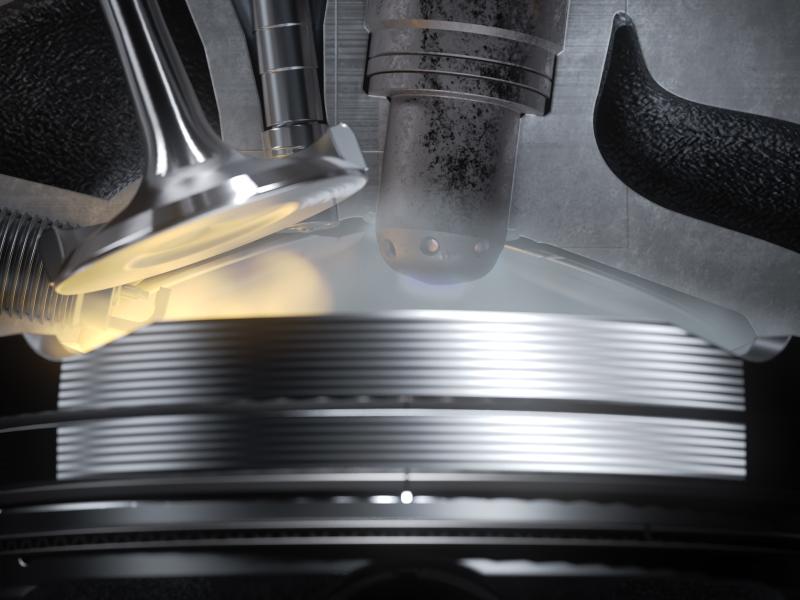
The 849 Testarossa Spider’s internal combustion engine (project code F154FC) is the latest version of Ferrari’s multi-award-winning twin-turbo V8. It produces 830 cv with a specific output of 208 cv/l, marking a 50 cv increase compared to the previous iteration. This achievement was made while maintaining the same displacement and completely revising the components, including the all-new turbocharger, cylinder heads, engine block, exhaust manifolds, intake plenums, titanium fasteners, valve train system, and fuel rail.
A new, larger turbocharger has been adopted with F80-derived low-friction bearings and an innovative heat shield on the turbine casing inspired by the 296 GT3 to improve thermal management in the engine compartment. The compressor wheels and the turbine have been optimised in terms of materials and aerodynamics, and a refined calibration strategy has been introduced, all to minimise turbo lag and maintain the responsiveness of the engine. The intercooler has been optimised in order to manage the increase in power and improve thermal efficiency.
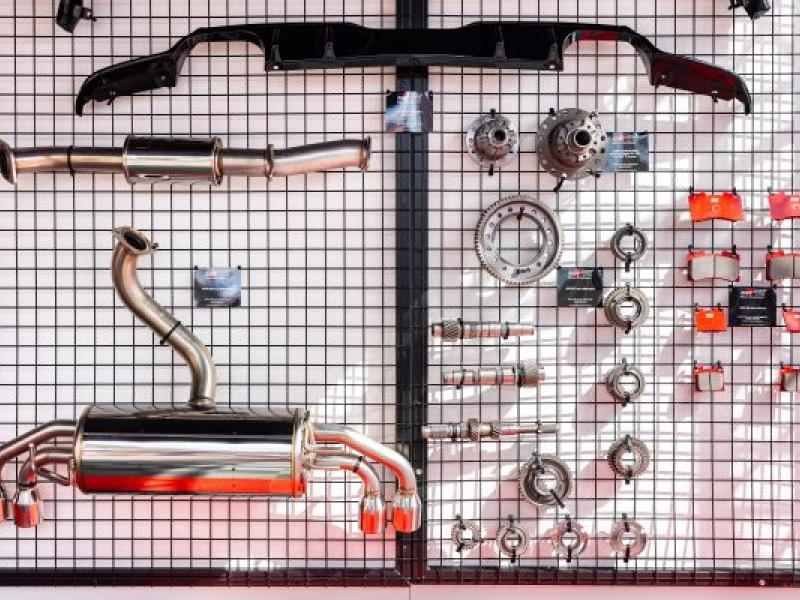
The Inconel exhaust manifold sees the diameter of the ducts increase by 20 percent and its length by 10 percent to improve the performance and provide the timbre typical of the Ferrari sound. The adoption of a flexible Inconel joint manages extremely high temperatures without increasing weight. The exhaust system integrates GPFs and a new generation ceramic matrix for the catalysers, which keep the layout unchanged while complying with regulatory requirements without any significant increase in mass.
Electric motors and hybrid system
The 849 Testarossa Spider adopts a PHEV architecture derived from the SF90 Spider, combining the V8 internal combustion engine with three electric motors for a total power of 220 hp. Two of them are located on the front axle and make up the RAC-e (electronic cornering set-up regulator) system which enables the 4WD system and torque vectoring to maximise traction and efficiency when exiting corners. The third electric motor, the MGU-K (Motor Generator Unit, Kinetic), is positioned on the rear axle and derives directly from the Scuderia’s experience in Formula 1.
The battery and electric motor management strategies are calibrated according to the four electric driving modes that can be selected via the eManettino – eDrive, Hybrid, Performance and Qualify – optimising performance in all conditions. In eDrive mode, the car can travel up to 25 km in electric drive only thanks to the 7.45 kWh lithium-ion battery which is installed in the chassis to ensure a low centre of gravity and optimal weight balance.
Sound
The 849 Testarossa Spider introduces a new sonic dimension that reflects the essence of the car, with a powerful and pure character. The timbre of the new V8 turbo has been optimised to ensure a recognisable acoustic signature in all driving conditions, while preserving the distinctive harmonics of Ferrari’s V8.
Aerodynamics
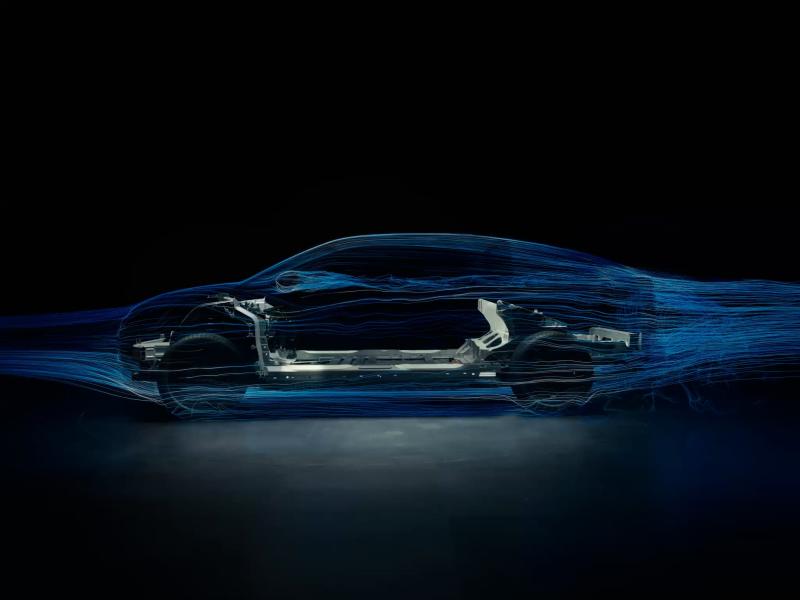
The main objectives of the 849 Testarossa Spider’s aerodynamic design were to optimise thermal performance and increase downforce, drawing inspiration and reference from historical and contemporary racing solutions, such as those seen on the 512 S, the 512 M and the FXX-K. The 849 Testarossa Spider generates a total load of 415 kg at 250 km/h, an increase of 25 kg compared to the SF90 Spider, while cooling performance improves by 15 percent.
Thermal system
The 50 cv increase in power of the internal combustion engine required a 15 percent increase in the capacity to dissipate thermal energy. The coolant radiators have been redesigned with asymmetrical geometry, achieving an 18 percent increase in the radiating surface. The radiator for the hybrid components has been adapted to the new front volume. The side intercooler, borrowed from the F80, has a 19 percent larger surface area and a reduced inclination to reduce its height in the chassis.
Vehicle dynamics
The vehicle dynamics of the 849 Testarossa Spider have been developed with the aim of improving absolute performance, its consistency and accessibility, while maintaining a high level of driving pleasure. The project took the SF90 Spider as a reference, focusing on increasing power, tyre grip and response, the efficiency of the braking system and the evolution of electronic controls through the Ferrari Integrated Vehicle Estimator (FIVE) digital system, to provide even the most demanding drivers with maximum driving thrills.
When developing the handling of the 849 Testarossa Spider, Ferrari’s engineers set out, as usual, to define driver feedback using five indicators: lateral and longitudinal acceleration, gearchange, braking and sound. Lateral acceleration was optimised by working on the suspension geometry and management of the electronic vehicle dynamics controls to provide a faster response to steering wheel inputs and improving the mechanical grip of the rear axle.
The FIVE system represents a significant evolution in dynamic controls. It is an estimation system capable of creating a digital twin that replicates the behaviour of the car in real time, based on a simplified mathematical model powered by real measurements (acceleration, 6D sensor). FIVE accurately estimates performance characteristics that cannot be directly measured, such as speed (with a margin of error of less than 1 km/h) and yaw angle (margin of less than 1°) of the vehicle, improving traction control, electronic differential management and e4WD system delivery. These estimates feed into all vehicle dynamics controls, making the response more precise and repeatable.
The ABS Evo, for example, uses the FIVE estimates to determine the target slippage of the four wheels and optimise braking distribution. The system is active in all positions of the Manettino and in all grip conditions. The improved speed estimation makes it possible to better exploit the longitudinal force of the tyres, both in straight and combined braking (brake then turn-in) situations, reducing dispersion due to component tolerances or environmental variability. The result is later, harder braking that is more repeatable than the SF90 Spider, with a level of electronic control efficiency that is higher than in any other Ferrari range car.
Tyres
The tyres, as per Ferrari tradition, have been co-developed through intense refinement work in collaboration with Michelin, Pirelli and Bridgestone. This co-development has produced specific solutions for the most diverse needs. Available technologies include Michelin Pilot Sport Cup2R (on request), Michelin Pilot Sport Cup2 (Assetto Fiorano), Pirelli PZero R (standard) and Bridgestone Potenza Sport (standard, also in run-flat version). Each solution has been co-designed through joint virtual and physical sessions to ensure optimal performance in various contexts, with a focus on maintaining driving emotions, increasing pure performance and behaviour in medium-grip conditions. The measures adopted are 265/35 R20 at the front and 325/30 R20 at the rear.