


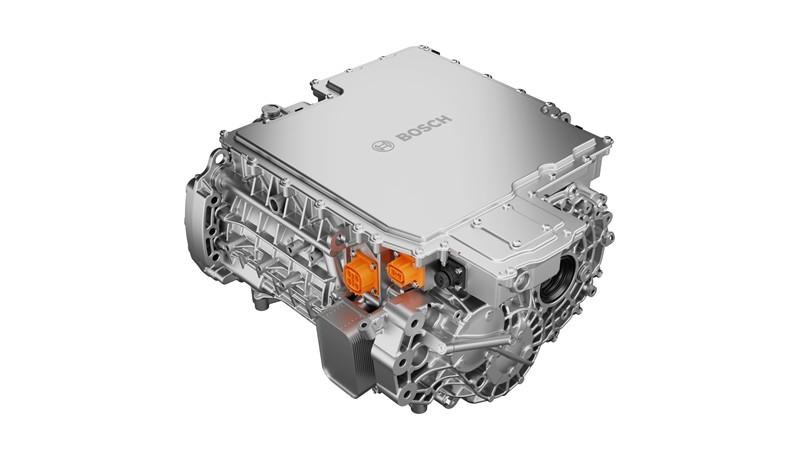
Bosch powertrain solutions: powerful and efficient
In the powertrain domain, Bosch is responding to the growing requirements of software-driven mobility and is developing sophisticated solutions. Following a technology-neutral approach, Bosch offers concepts for powertrains ranging from combustion engines to electric motors.
Silicon-carbide semiconductors for electromobility: Automakers, automotive suppliers, and distributors can draw on a wide range of Bosch silicon-carbide (SiC) power semiconductors for diverse automotive applications. Silicon carbide is seen as a key technology for electromobility.
By 2030, Bosch predicts that one in three newly registered cars and light trucks will be battery-electric. In electromobility, the Chinese market is setting the pace. Here, scalable and standardised platforms are crucial in making innovations universally available and affordable.
A global platform for a wealth of variants
Oil-cooled Bosch e-axles can be used as primary or secondary powertrains. They are globally available and locally adaptable. The 3-in-1 e-axle combines an electric motor, power electronics, and transmission. Bosch is adding further energy management components to its e-axle, such as an on-board charger, a DC/DC converter, and a power distribution unit. This combination of several functions in one unit offers a number of benefits, including a more compact design, lighter weight, and optimised costs, while increasing efficiency.
From electric vehicle to mobile energy storage unit
Although they take up 30 percent less space, the latest generation of bidirectional charger converters, which combine an on-board charger with a DC/DC converter, are even more efficient. This systems solution is much easier to integrate, whether close to the powertrain in the e-axle or close to the battery. With bidirectional flows of energy, an electric vehicle can also function as a mobile energy storage unit.
Inverters with greater power density
A new generation of inverters featuring power modules and semiconductors as well as innovative inverter topologies is paving the way for significant progress in power density and efficiency. Automakers can benefit from a globally standardised technology platform comprising various electric motors and active components such as rotors and stators.
Increased range, reduced charging time :
Standardised hardware means that intelligent software is gaining in significance. It can be used to extend range and curtail recharging time. Synchronous control (voltage modulation) allows efficiency to be increased by 1.5 percent, and an electric vehicle’s peak power and continuous output by 10 percent. Solely by using software, switching behaviour can be synchronised with the rotation of the electric motor, without modifying the hardware. Through the software feature eAxle Heating, the electric vehicle’s battery is optimally preconditioned prior to charging.
Optimum battery temperature
Thermal management systems can further increase the efficiency of hybrid and electric vehicles. By deliberately controlling flows of cold and heat, they ensure that the high-voltage battery remains within the optimum temperature window at all times, that the electric motor does not overheat under heavier loads, and that as little electricity as possible is used for cooling and heating. For this, Bosch is developing pre-integrated modules that combine essential elements such as electric cooling compressors and coolant pumps. This considerably reduces complexity and installation effort. In new systems, the coolant used is propane (R290), which is already used in heat pumps and tumble dryers.
Intelligent coordination of energy management
The modular software solutions used in Bosch Vehicle Energy Management distribute energy in the vehicle in an especially intelligent way. An integrated approach coordinates and optimises energy management and its component subsystems such as thermal management, powertrain, on-board network, and charging system. This connected system also takes account of current and forecast vehicle parameters, as well as of road conditions and driver behaviour.
Safety in critical operating states
Together with its electronic disconnect unit, the Bosch battery management system monitors and controls the high-voltage battery’s cells – in both electric cars and plug-in hybrids. In critical operating states, it provides the necessary safety mechanisms. It also optimises power output and battery life. It comprises a control unit as well as elements that are attached to the individual battery modules and that monitor each individual cell. Software functions, such as the battery passport that will be required in the EU from 2027, can also be integrated. In the event of an accident, the electronic disconnect unit disconnects the battery from the vehicle electronics. The battery management system, the cell monitoring units, and the charger-converter can be brought together in this disconnect unit, thereby reducing complexity.
New battery for the on-board network
To meet ever greater demands for power, more and more electric vehicles will feature a 48-volt on-board network in the future. To satisfy this need, Bosch is developing a 48-volt lithium-ion battery – in addition to the 48-volt battery for mild hybrids it has already manufactured millions of times.
Bosch ESI[tronic] adds Tesla to its diagnostic programme
The range of vehicles covered by Bosch’s tried and tested ESI[tronic] diagnostic software now also includes Tesla models. For the first time, therefore, independent workshops will now be able to use their everyday multibrand solution to perform extensive diagnostic work on Tesla model .