


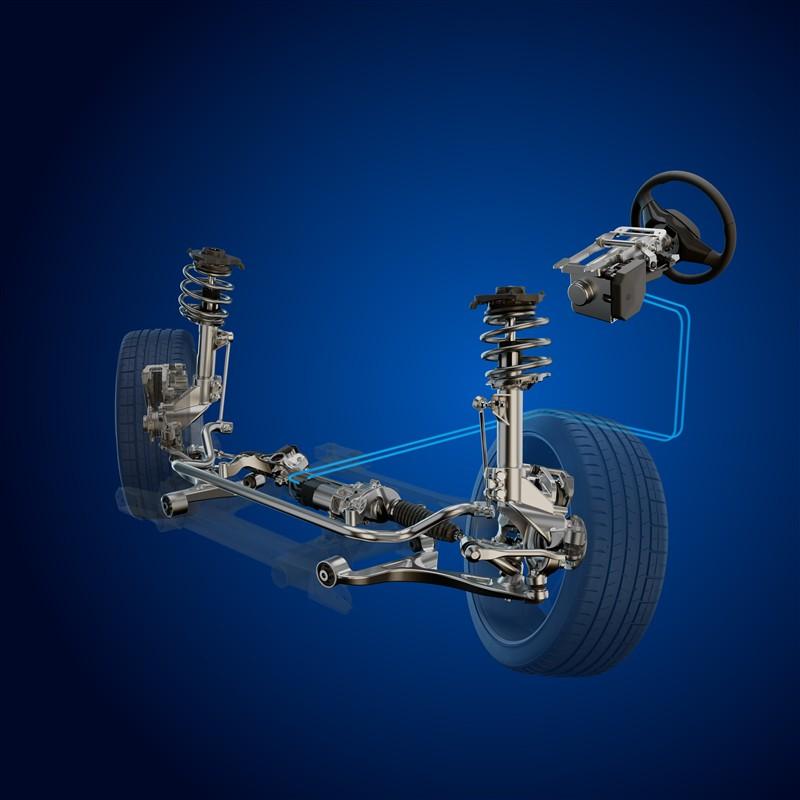
With steer-by-wire, the fixed mechanical transmission between the steering wheel and the wheels, is replaced by variable, pure software connection. This provides almost limitless possibilities for the design of the steering-ratio. In modern, software-defined vehicles, the technology ensures more precise manoeuvring, more stability and safety as well as optimal responsiveness. In addition, the Steer-by-Wire system allows for new steering wheel and cockpit designs. The electronic connection between steering components paves the way for seamless integration of autonomous driving functions up to Level 4 and beyond. ZF draws on decades of expertise and deep system know-how to drive this innovation forward. The most recent example: the combination of steer-by-wire and the ZF EasyTurn axle concept.
Steer-by-wire: A key technology for advanced driving dynamics and automation
In contrast to traditional steering systems, steer-by-wire eliminates the mechanical connection between the steering wheel and the steering gear. Steering force is generated by a mechatronic actuator positioned between the wheels. The driver’s steering input is captured by a steering wheel actuator in the cockpit, featuring precise angle-of-rotation sensing.
A torque feedback unit – a small electric motor at the steering wheel – recreates the natural steering feel and road feedback. The ZF system, designed with redundancy for safety, dynamically adjusts the steering ratio to suit different driving speeds and conditions. This means the angle of the steering wheel is optimally translated into the wheel angle: A direct ratio for greater agility during parking, and a more indirect ratio for enhanced stability and comfort at higher speeds.
Drivers can feel the difference immediately, and for manufacturers, the benefits are just as compelling. ZF’s steer-by-wire technology delivers the bandwidth for a precise, comfortable and safe steering feel, with outstanding responsiveness and enhanced dynamics. The cockpit and interior can be designed more freely, offering increased space and comfort for passengers. The technology also enables new steering wheel geometries, including foldable steering wheel rims. Without the need for an intermediate steering shaft, there is no longer a requirement to route components from the interior to the engine compartment. This streamlines both the assembly and positioning of steering components, while also making it easier to adapt platforms for different model series or markets, whether for right-hand or left-hand drive. Eliminating the intermediate steering shaft also helps reduce noise transmission and enhances passive safety.
In addition, steer-by-wire technology provides the essential foundation for cutting-edge driver assistance systems. While mechanical steering systems support ADAS functions up to Level 3, steer-by-wire enables capabilities up to Level 4 and beyond. This also includes future active safety features such as Automated Emergency Steering (AES).
One fits all: software algorithms instead of mechanics
Steer-by-wire also offers the advantage of enabling steering and driving dynamics to be fine-tuned entirely via the software. As a result, manufacturers can express their brand’s unique driving feel through software alone. There is no longer a need to design mechanical variants for different models and configurations.
Twin Worm enables a brand-specific steering feel with maximum compactness
Driving is always an interaction between the driver, the vehicle and the road. That’s why the feedback felt through the steering wheel is so crucial – for both safety and driving pleasure. Developed by ZF, the Torque Feedback Unit featuring the patented “Twin Worm” concept combines the bandwidth for outstanding steering feedback and precision with a compact design – delivering the highest torque-to-size ratio in its class.
The ZF Twin Worm Unit uses two independently software-controlled worm drives that work in tandem to generate precise steering feedback and feel for the driver. This design not only provides system redundancy but also allows for exceptionally precise control. “Thanks to this mechatronic system and its specialised control software, we are able to completely – and more importantly, precisely – eliminate the inherent backlash found in gear mechanisms,” explains Stéphane Cassar, Head of the Steer-by-Wire product group at ZF.
Friction and backlash within steering systems are key factors that influence how comfortable the driving experience feels. In the ZF Twin Worm system, these parameters are not replicated through complex mechanical means or additional components like springs and dampers. Instead, they are managed entirely through the advanced, software-based control system mentioned above. “Our Twin Worm concept makes all of this much easier to achieve,” says Cassar. The steering ratio and with it, the maximum steering wheel angle can be widely adjusted. In fact, it can be reduced to as little as 180 to 210 degrees, opening the door to entirely new, flatter steering wheel designs. As a result, shuffling hands is no longer necessary whilst steering. As the system meets the highest level of functional safety (ASIL-D), it is fully compatible with automated driving functions up to Level 4 and beyond.
EasyTurn: Exceptional agility with front axle steering
Thanks to the Group’s expertise in steer-by-wire technology, the EasyTurn suspension strut front axle system has seen a significant enhancement. With EasyTurn, the maximum steering angle of the front wheels doubles from 40 to 80 degrees, reducing the turning circle of a typical mid-size car from over ten metres to under seven. “As long as we relied on mechanical linkages, we eventually hit the physical limits of the required steering angle. That’s no longer the case with steer-by-wire – now, even the slightest steering wheel movements are enough to manoeuvre in the tightest spaces,” explains Peter Kontermann, Project Manager for EasyTurn at ZF.