


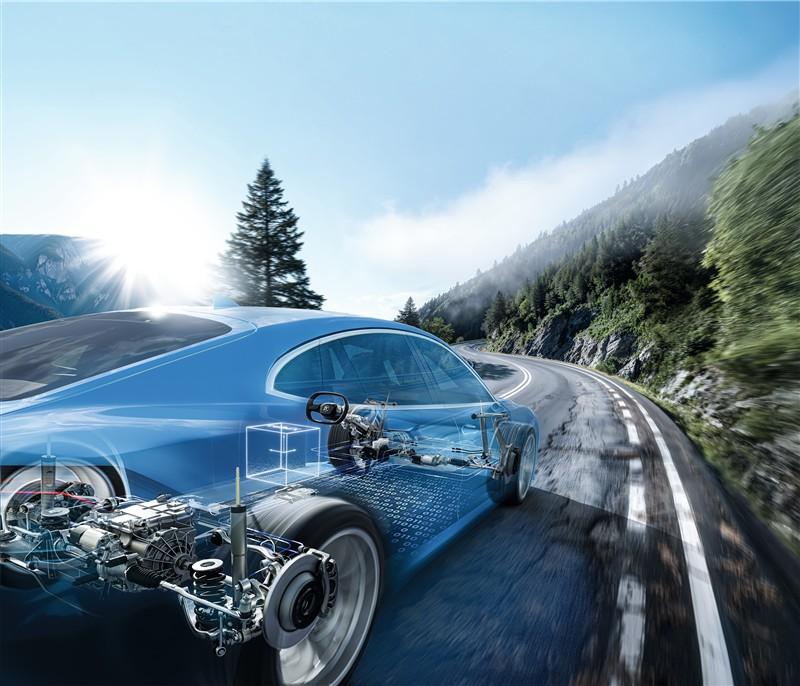
The Software-Defined Vehicle (SDV) has moved from concept to reality. Building on a foundation of innovative by-wire technologies like steer- and brake-by-wire that enable software-based functionality, ZF is now setting the standard in chassis innovation with new software products. As part of its Chassis 2.0 strategy, which combines smart hardware, artificial intelligence and software to enable new functionalities and personalised features, ZF introduced two new software products at CES: AI Road Sense and Active Noise Reduction.
AI Road Sense: Navigating the road ahead
With AI Road Sense, ZF presents an innovative, AI-based solution that enhances safety and comfort in software-defined vehicles. The system uses state-of-the-art sensors to adapt the chassis in real time to changing road and surface conditions – whether on wintry roads, off-road terrain, or when switching between different types of pavement. This raw data is then processed and utilised by ZF’s chassis software cubiX to coordinate the control of smart actuators such as our semi-active damping system Continuous Damping Control (CDC) or our active damping system sMOTION. The latter reacts within one millisecond to adjust the dampers. Future smart actuator integration will include steer- and brake-by wire for even more advanced control and capability.
“AI Road Sense can help reduce drivers’ uncertainty when facing challenging road conditions. The system detects specific situations in fractions of a second and reacts faster than human reflexes allow. This means the vehicle’s behaviour always meets expectations, strengthening both confidence and the sense of safety at the wheel,” says Holdmann.
The scalable system is available in three versions: Standard, Advanced, and Premium. Even in the standard configuration, AI Road Sense uses CAN bus signals to identify the current road type. The Advanced version adds camera data, enabling predictive surface detection and analysis. The Premium configuration expands the system with LiDAR technology, which scans the road profile up to 25 metres ahead with an accuracy of two centimetres, creating a detailed 3D terrain profile for precise chassis adjustments.
ZF System expertise pays off
A particular highlight is the intelligent linking of sensor and chassis data. Here, ZF benefits from its system expertise. While a camera alone would recognize snow only as a uniform surface, ZF combines camera signals with chassis signals such as tire slip and torque increase. This allows AI Road Sense to distinguish between deep and shallow snow and optimally adjust the vehicle to the situation.
In this example, if the system detects slippery roads, the “Snow Start” is automatically activated: the vehicle starts with reduced torque to prevent wheel spin and tire slippage. The AI detects the depth and firmness of the ground– whether mud, sand, rocks, or snow– and automatically selects the optimal drive strategy. All-wheel drive and differentials are intelligently pre-locked to optimally distribute power, even in deep ruts.
Another advantage: AI Road Sense works in the background – without the user needing to know or select driving modes. For example, when switching from a gravel road to the highway, the system immediately switches to a quiet, energy-saving mode.
Advanced personalised comfort now possible
For a premium and customised driving experience, the software can also enable Driver Behaviour Recognition, analysing throttle, brake and steering inputs along with in-vehicle and external conditions to predict driving style and preferences for enhanced comfort. This capability enables a highly personalized and adaptive driving experience across chassis and powertrain systems, reinforcing ZF’s commitment to innovation and delivering OEM-specific brand experiences.
Active Noise Reduction
ZF also unveiled its Active Noise Reduction software, a technology that minimises in-vehicle “tyre-cavity” noise without additional noise-dampening hardware. The system uses ZF’s Next Generation Smart Chassis Sensors as well as semi-active dampers (CDC) that are controlled by ZF’s cubiX software to counteract vibration noise, achieving noise reductions of up to three dB now and up to 10 dB in the future. This innovation, part of ZF’s Chassis 2.0 strategy, will enter series production in 2028 and can be adapted across vehicle types.