


All vehicles used on Australian roads, must meet ADRs (Australian Design Rules), a set of national standards that cover minimum safety, anti-theft and environmental requirements that each vehicle must meet to legally operate.
Along with applying to all new vehicles sold, any modifications or deviations that are made to existing vehicles – which could alter the structure, suspension, handling, restraints, safety and emissions systems – must also meet ADRs.
For the vehicle to be compliant (and not affect the driver’s insurance claim should an accident occur), owners who go down the modification path, especially with components such as brakes, should seek out upgrades that are ADR-approved.
Companies such as Bendix invest heavily in ADR testing programs to ensure that relevant products tick all the regulatory boxes. The process is managed from Bendix’s Ballarat, Victoria, Research and Design Centre and Manufacturing Facility, by Bendix engineers who provide input based on their extensive experience developing braking components for demanding Australian conditions and applications.
Ultimate 4WD big brake upgrade kits – testing example
As products that deviate considerably from OE brake components to significantly improve performance, Bendix’s Ultimate 4WD Big Brake Upgrade Kits have been extensively tested by Bendix and are ADR-compliant.
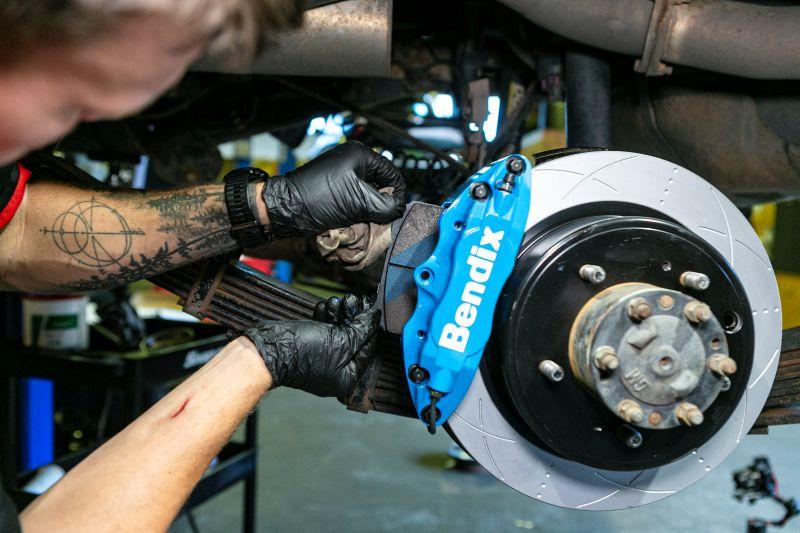
The front kits introduce larger (365mm) diameter Ultimate 4WD Disc Brake Rotors, along with more powerful Bendix 6-Piston monoblock calipers with bracket mounting kit, and Ultimate 4WD Brake Pads and Braided Brake Hoses.
At the rear, Bendix offers its Ultimate 4WD Big Brake Upgrade Kit; a full drum to disc conversion, that removes all OE drum assembly and replaces it with the Bendix Ultimate 4WD disc rotors and hydraulic calipers. The installation requires the removal of all components from the vehicle axles, which is why the kit comes complete with replacement bearings and seals (ABS rings and collars depending on vehicle model).
Both kits were developed using CAD with relevant bracketry and components undergoing FEA (Finite Element Analysis), which employs in-lab calculations, modulations and simulations to understand how an object might behave under various physical braking conditions.
In vehicle testing is then undertaken at a proving ground with each test car fitted with detailed instrumentation and measurement equipment including decelerometer, pedal effort gauge and other sensors and monitors. All results are then reviewed and validated by an independent vehicle engineering agency before products are permitted to move from prototype phase to full production.
Owners of these kits can rest assured that they’re 100 percent legal and ADR-compliant and will perform as they should without adversely affecting other vehicle dynamics.
www.bendix.com.au