


API ‘starburst’ and ‘donut’ licenses
API license two types of Marks or Licenses: A Certification Mark commonly referred to as a “Starbust” and a Service Symbol, commonly referred to as a “Donut”. These Marks identify a quality, API licensed motor oil petrol and diesel powered engines. API have designed these licenses that define, certified and monitor engine oil performance that vehicle and engine manufacturers as well as the lubricants industry have considered necessary for satisfactory engine life and performance.
They are intended to assist the end user to identify products that have satisfied the requirements for licensing by the API and therefore provides confidence in the quality of the oil they are purchasing. In some countries, a lubricant cannot be sold without an API quality Mark.
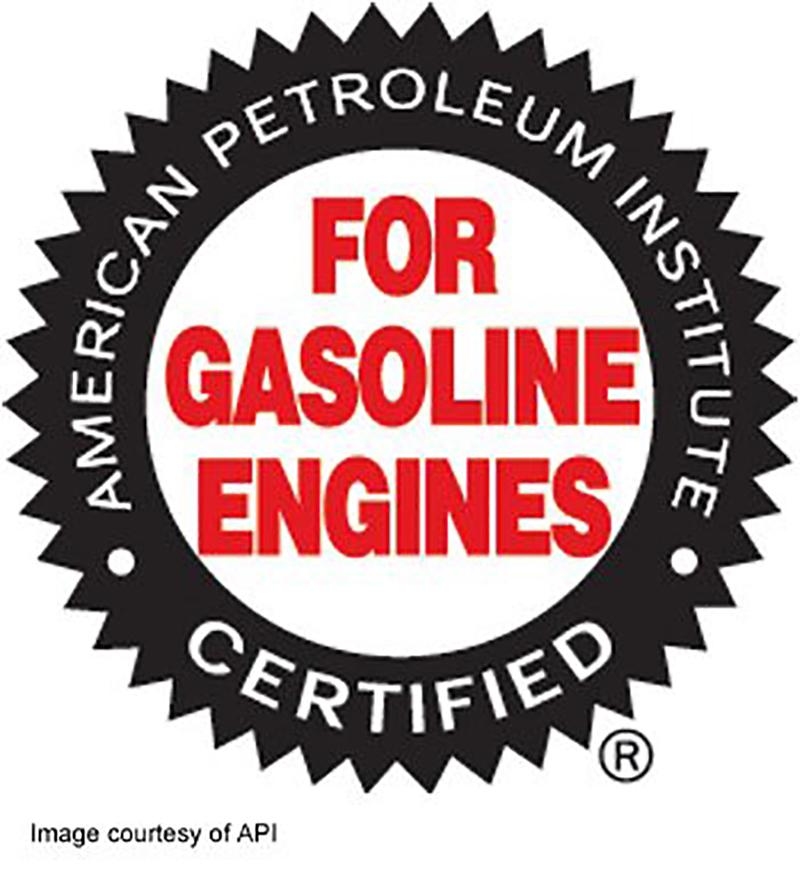
API certification mark or ‘starburst’
An oil showing this Mark identifies it as meeting the current ILSAC (International Lubricant Standardisation and Approval Committee) performance standard for engine protection and fuel economy requirements. The ILSAC GF-5 minimum performance standard is the current basis for issuing a license to use the API Certification Mark or “Starburst.
API service symbol or ‘donut’
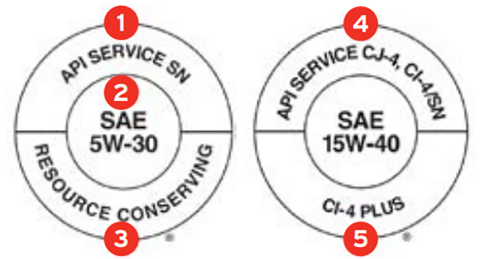
An oil displaying a “Donut” denotes a licensed oil’s performance properties through the use of API ‘S’ Service Categories and, if applicable, the Resource Conserving and API “C” designations. Below are examples of “Donuts”. API Donut.
Different parts to the service symbol or ‘donut’
1. Performance level
This will indicate the API performance level attained by the oil. Petrol engine oil specifications are designated by API ‘S’ Service Categories, in this case, API SN. The use of more than one API ‘S’ Service Category in this section of the Service Symbol is prohibited. Diesel engine oil specifications are designated by API ‘C’ categories, such as CJ-4.
2. Viscosity grade
This is where the viscosity grade of the licensed product is shown.
3. Resource conserving and energy conserving
These designations apply to oils intended for petrol engine use. Using these oils may result in an overall saving on fuel use or increased fuel economy.
4. Multiple performance levels
This section may include more than one API performance level. Oils designed for diesel use might also meet a petrol performance level. In this case, the ‘C’ category is listed first followed by the ‘S’ category.
5. Service symbol with CI-4 plus
The ‘CI-4 PLUS’ designation identifies oils that are formulated to provide a higher level of protection against soot related viscosity increase and viscosity loss due to shear in diesel engines. When originally introduced, ‘CI-4 PLUS’ identified CI-4 oils meeting a higher level or performance. CJ-4 oils include all ‘CI-4 PLU’” performance requirements. In this case, the ‘CI-4 PLUS’ appears in the lower portion of the ‘donut’. This portion is also known as where the Performance Designation is listed.