


If my memory serves me right, other than a couple of Jeep technical bulletins, I have never written a Jeep article for anyone. It’s not because I might offend a passionate Jeep owner. It’s because it’s rare to see non-specialist Jeep workshops take on a Jeep. They do have a special charm, Jeep owners. Some are diehard Jeep all their lives. But many were tickled by the amazing Australian marketing campaign that famously used The Potbelleez hit track “Don’t Hold Back” (released in 2007) as its core musical backdrop in 2011. Combined with its sexy styling (I think inspired by the Ford Ranger PX), many Aussies and Kiwis became obsessed, and it became a dream car for many.
Haynes Pro Jeep.
The popular model release was the Grand Cherokee Jeep (WK2) 3.0 CRD V6 fitted with the VM23D (EXF) 177Kw 3.0 CRD V6 and what came later, the VM44D 2011 – 2021. Admittingly, I took a fancy too. Until I found out the long list of issues that ridiculed them early days. At the time I was working for Frizelle Gold Coast VW Commercial, another brand franchise alongside Jeep. The Jeep techs were working around the clock trying to keep on top of warranty claims on most parts of the engine and other drive components.
One key component of the Jeep, which was rarely an issue, is the Bosch fuel system. A brand I class as the best diesel fuel system manufacturer. And no, I’m not paid by Bosch to say this … though I should be.
Getting back to the key focus of the fault I will share in this article, it’s not the fault of the vehicle. It is common component fitted to some Common Rail Diesel fuel systems, is the failure of the low-pressure fuel electric supply pump. Some CRD have these fitted on the chassis rail, within the fuel filter assembly or inside the fuel tank. Some OEM such as BMW run one in the tank and another on the chassis.
They eventually wear out and will completely shut down the engine, preventing it from restarting. Some of you may have read my previous articles, I mention that CRD can run without the aid of an electric supply pump and you can simply connect a separate fuel supply to get it started and running. Today, there is a mixture across the diesel car park. But my history with diagnosing Jeeps and affiliated vehicles such as Fiat/Chrysler, they are 100 per cent dependent on this in-tank pump and depending on the model, they require a minimum feed pressure value to ensure the engine starts and runs without faults or failures.
Symptoms:
Vehicle would stall occasionally, especially after driving, when the engine was warm. Difficult to start would occur more often when warm and when the fuel tank level was less than half.
Diagnosis and/or early detection of the fault:
Before replacing the pump, there are other parts of the low-pressure fuel supply system which may impede the pressure to supply adequately. As mentioned previously, this model will not operate on a separate fuel supply.
The ECU has a strategy in place to monitor the rail pressure when the ignition is switched on. The in-tank supply pump will be active immediately to produce enough pressure for the monitoring system to enable full starting and running of the engine.
If the pressure is below the minimum desired fuel pressure, the ECU will prevent power supply to the injectors, thus preventing the engine from starting. We have found 3.5 bar to be approx. minimum fuel pressure required to meet the strategy. This is not the exact specification as we can only provide the minimum pressure that has been determined by previous cases. But don’t lock this pressure in for all CRD low pressure fuel supplies. We diagnose a similar problem on the Mitsubishi Canter and it requires 4.1 bar exactly.
Placing your finger over the fuel pipe outlet, activating the pump and splashing everyone with diesel, is not a reliable monitoring system.
To confirm the low supply pressure meets its 3.5 bar minimum, install an inline pressure gauge between the fuel filter and the tank. Preferably a liquid filled with a range between 0 to 20 bar.
Turn the ignition on or if possible, use your scan tool to activate the in-tank pump and observe the pressure. It should reach this minimum of 3.5bar within a couple of seconds.
If there is a reading of less, the engine may still start and run but this will depend on how much fuel is in the tank at the time. Higher level will increase the head tank weight, thus assisting the flow of the fuel, increasing the pressure by way of gravity force. In other words, the higher the fuel level, the more push the fuel has behind it.
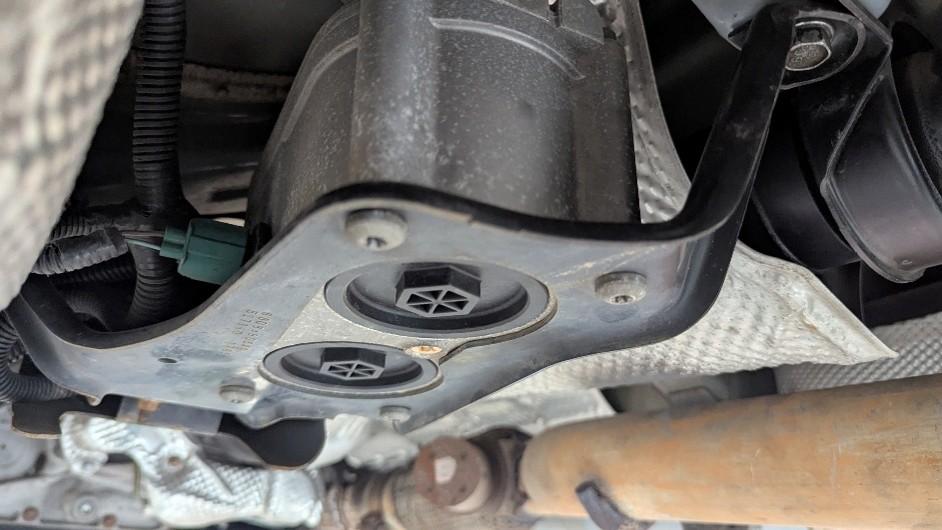
Another test that can assist to confirm the in-tank pump has failed, is performing a current draw test. Using an amp clamp at the pump relay or pump itself, when active amperage must remain approx. 3.5 amps. To locate the pump, it can be found on the passenger side chassis rail.
See image: Low pressure pump passenger side chassis rail.
If there is no amperage draw at all, confirm there is a good quality power supp ly to the in-tank pump. If not, start checking the power at the pump and work your way back to the fuses and relays. Carry out a continuity test, confirm adequate battery power and quality earths. Some vehicles use an activation switch as part of the driver’s door to assist pre-priming.
For testing the electrical circuit, refer to HAYNES PRO Component diagnosis : H2 - Fuel pump with level sensor
See image: Haynes Pro Wiring Jeep.
Solution:
Once the pump has been confirmed to have failed, remove and replace it with genuine only and remove the entire tank for full clean.
Special notes:
Most in-tank pumps require minimum pressure to prevent failures of the main system. Low pressure can be caused by contaminated fuel such as water or petrol so if this was to enter the high-pressure system, major damage is likely to occur.
Often there is no filtration prior to these pumps, and therefore the average life of these supply pumps is approximately 150,000km to 200,000kms. As preventative maintenance, I strongly advise replacing these supply pumps every 150,000kms.
By Clinton Brett Clinton is a leading diagnostic diesel trainer from Diesel Help Australia • dieselhelp.com.au