


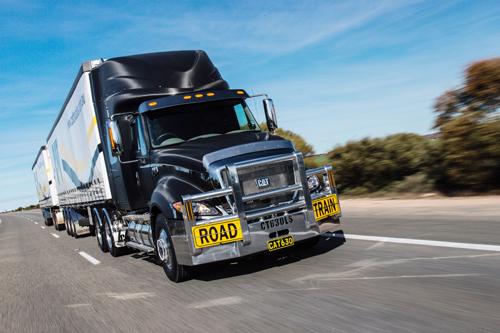
The long-term future of Cat trucks in Australia and New Zealand will not be impacted by the recent decision of Caterpillar Inc. to discontinue production of its vocational models in North America.
North American vocational models have never been available in the Australian and New Zealand markets and are built on an entirely different cab and chassis platform than the CT610 and CT630 on-highway units sold in Australia since 2010.
For Australia and New Zealand, Caterpillar’s announcement to end production of North American vocational models will have no effect whatsoever.
“It is business as usual for Cat truck dealers in Australia and New Zealand,” says Glen Sharman, director of sales, marketing and business development.
Since the launch of Cat trucks in Australia in 2010, the range has been extensively expanded with purpose-built models such as the spacious CT630LS, the CT630SC specifically engineered for B-double duties and most recently, the roadtrain triples-rated CT630HD.
“We can assure everyone, particularly current and prospective Cat truck customers, that Caterpillar’s announcement has no bearing on our business in Australia and New Zealand,” Glen Sharman concludes.