


This article focuses on the many tests that I advise when testing most Variable Geometry Turbos (VGT). Why go to so much length to diagnose when it’s often the actuator that fails? Well because that’s not entirely correct. Unbeknown to many, the cause of the actuator failure is often the internal mechanical vanes of the turbo housing grabbing. So, it won’t be long and the vehicle will return with another long list of relatable fault codes.
We don’t make this stuff up. With more than 300 hundred Diesel Help members logging an average of seven turbo related diagnostic request per week, 50 percent of these are working with heavy on and off highway machinery, experiencing these faults and issues.
This information is from one of our latest technical bulletins created for our members – TB1309 Hino J07E turbo faults P0046, P0047, P0108, P0237, and P0234. (https://www.dieselhelp.com.au/2026/05/06/hino-500-turbo-faults/) This has been common on the following model trucks and engines – Hino 500, Ranger J07E-TR, J07E-TNK, J07E-TP, J07E-TNU, J07E-TN 6.4L FC, FD, FE ENGINES.
However, we are using these testing methods for everything with a VGT turbo fitted. The best part of HVC, HV-Off highway and related content, we now have access to the world’s best and most valuable resources you can find in a diagnostics tool – Jaltest.
Not a paid advertisement
I am the Australian/NZ brand ambassador for Jaltest, but this is not a paid gig. It would be if I was using this tool everyday fixing vehicles to generate an income. We don’t provide such a service. I can access any scan tool I request to use as a demonstrator in our training. I am fortunate to be recognised by an influential figure for the brand, Jesús Romero, the Regional Sales Director of Jaltest Cojali S.L.
We met last year at the Brisbane truck show after he had read many of my articles. He refers to me as one of the industry’s leading diesel trainers. I won’t disagree with him. That’s what our feedback from participants has been for the past 13 years.
Thank you to our sponsors Bapcor, Bursons/Precision Automotive Equipment for their support behind this venture and for providing me with the entire Jaltest kit, laptop and all the cables. A recent visit from Jaltest engineer Pablo Lafuente, when realising I had every cable, he made the comment – Clinton you are equipped to take on every application. Yes, and unfortunately this increases my logistics expenses especially travelling to NZ. But it’s a smart business choice. I invest in training, so there’s no reason others shouldn’t.
Symptoms: Intermittently the vehicle goes into limp mode, engine de-rating due to fault codes: P0048 Turbo pressure control solenoid 1 circuit high, P0047 boost control solenoid, P0046 Turbo pressure control solenoid 1 circuit range/performance, P0237 Boost pressure sensor circuit low input, P0108 Boost pressure sensor circuit high input P0234 Turbocharger over boost
Failure/Issue: Turbo actuator sticking/seized
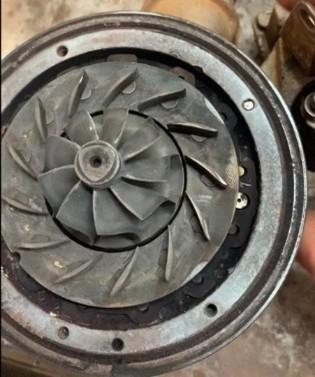
Diagnosis and/or early detection of the fault: The failure is narrowed down to the internal vanes of the Variable Geometry Turbo (VGT). They bind against turbo housing often caused by excessive carbon build up within, because of the exhaust passing through the turbine housing. Depending on the driving conditions, when this fault occurs. A vehicle participating in regular short stop start trips, mostly city driving with extensive idle, these conditions will decrease life, increasing the chance of early failure to these types of turbos.
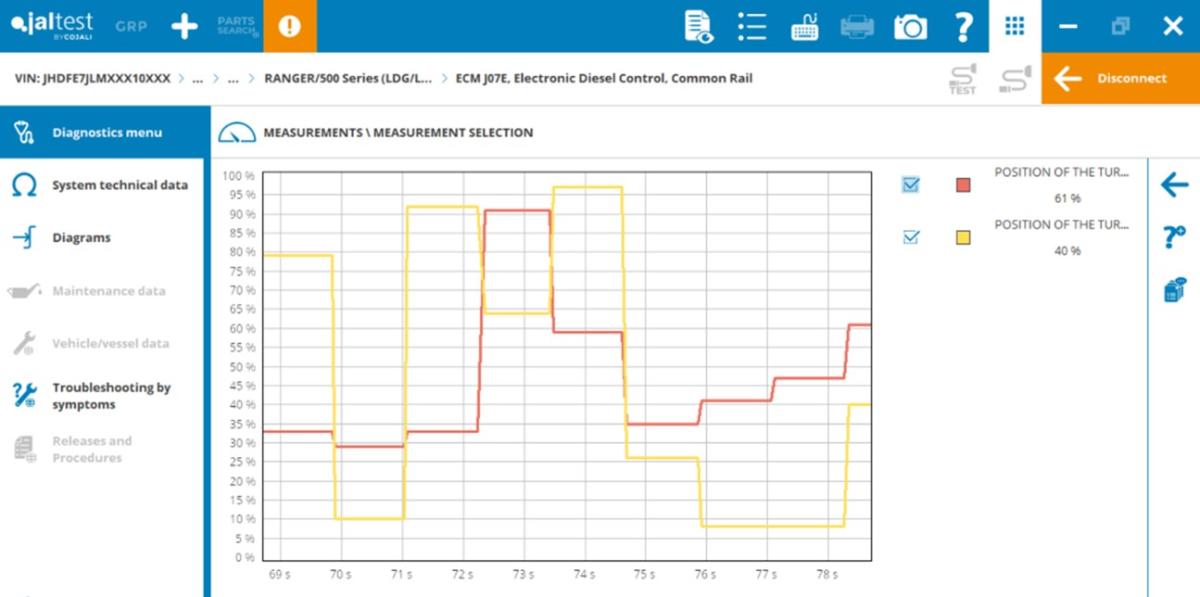
Before removing components for testing, it is possible to visually see what is occurring when referring to the scan tool data. Check key on engine off turbo actuator demand/command or desired V actual/measured position. Repeat the check again at idle and warm up the engine, driving underload and then returning to idle to recheck once the engine has become warm. Anything with a difference of more than 3.5 percent is enough to trigger a fault. Some OEM have greater tolerances. But this depends on the strategy level being used in the ECU.
Some examples of the scan tool data collected from cases:
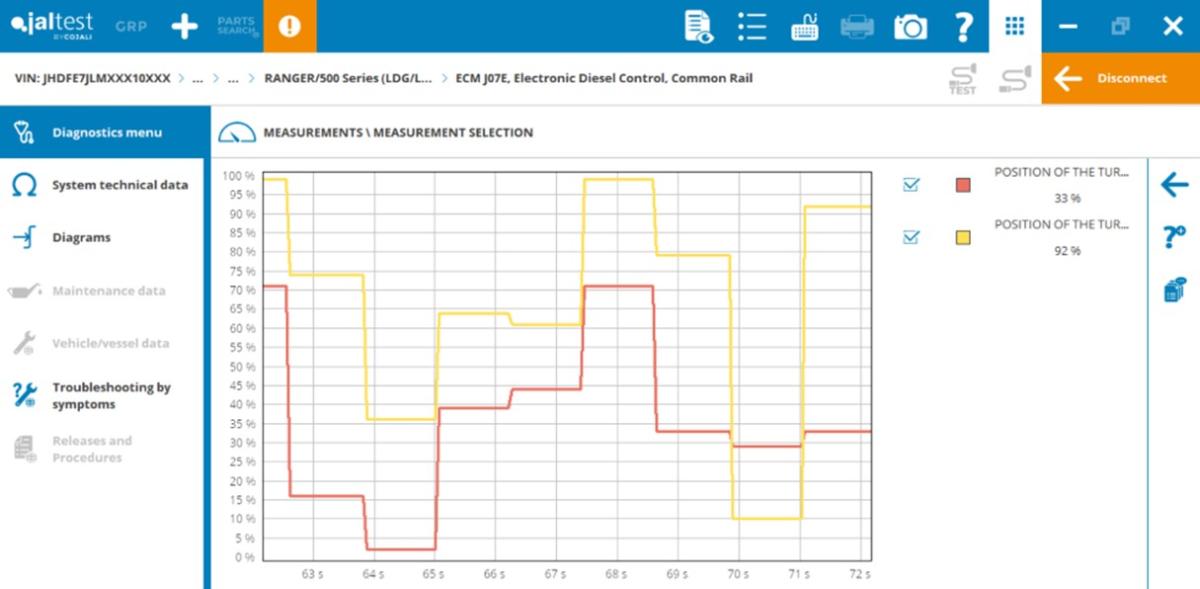
If you are still not satisfied with your findings on the scan tool, check the actuator arm for movement. When cold, remove the turbo arm away from the actuator and feel for freedom of movement. If there is any resistance when the turbo is cold, it will most likely be worse when warm. If the sticking is not present when the engine is cold, it is still vital to check when the engine is hot, as this is when the fault commonly occurs.
When checking for wear in the internal gears of the electronic actuator, there should not be more than 3mm of free play. On the mechanical section, the turbine housing, the arm should be free to move when disconnected from the turbo actuator. Check the stopper screws for wear. Never adjust these screws to improve drivability.
For final confirmation, we advise performing current draw test. Locate the power supply for the turbo actuator.
Below testing data is applicable to some of the Hino engines. Jaltest Info web provides a detailed wiring diagram and testing criteria accordingly. Check by entering the vin number.
Advise using an Amp clamp for testing cold and then hot. When warm, the amperage increases, which is when the failure is occurring. Check and compare the power supply to the turbo actuator. If the current drawing is found to be more than 2 amps, this is an indication of the turbo failure.
Solution: Replace the entire turbo assembly, preferably genuine only.
Special notes: These turbo actuators rarely fail without the cause being the internal vanes grabbing the turbo housing. When the vanes grab, the actuator current is greatly increased and often has caused the complete failure of the actuator to a point where it no longer actuates.
Advise using this turbo replacement guide. TB1060 – turbo failures all make.
The turbo replacement bulletin is listed under other replacement procedures we recommend: https://www.dieselhelp.com.au/fault_codes/replacement-procedures/
One more important note regarding the Jaltest. Since taking on this scan tool from October 2025, I found it the most adaptive diagnostic tool I have ever used since being involved with scan tools since the Bosch KTS in the late 90s. The wiring and flow diagrams have assisted me with our diagnostics; the technical explanation is valuable for apprentices to understand, and the on-vehicle testing procedures is easy to work with. I can turn up to our training courses with data groups saved from previous outings, reducing time when preparing the event.
My response to those who use heavy vehicle scan tools and have openly criticised the inability to connect 100 percent to everything they work on and comment it’s too expensive. You must remember that all heavy machinery and trucks don’t arrive in your country as a standard fit out. The number of accessories, upgrades, modifications and alterations applied to the application before the keys are handed over to the operator, are mind boggling. Some alterations are completed in house in the factory, and then at the dealership and outside the dealership. Jaltest visit all countries on a regular basis, accessing new non modified applications to download all the data enabling it to work with Jaltest for future diagnostics and repairs.
My role is to also provide regular feedback to assist with improving its capabilities and to educate on the many hidden features. Our training is not used for selling the tool. It is one of many strategies I access and utilize to my advantage of delivering the only experienced diesel diagnostics training available in this country.
https://www.dieselhelp.com.au/
Remember the saying – Poor man pays twice.
About the Author
Clinton Brett is the founder of Diesel Help Australia. Explore his Diesel Diagnostic Resources.