


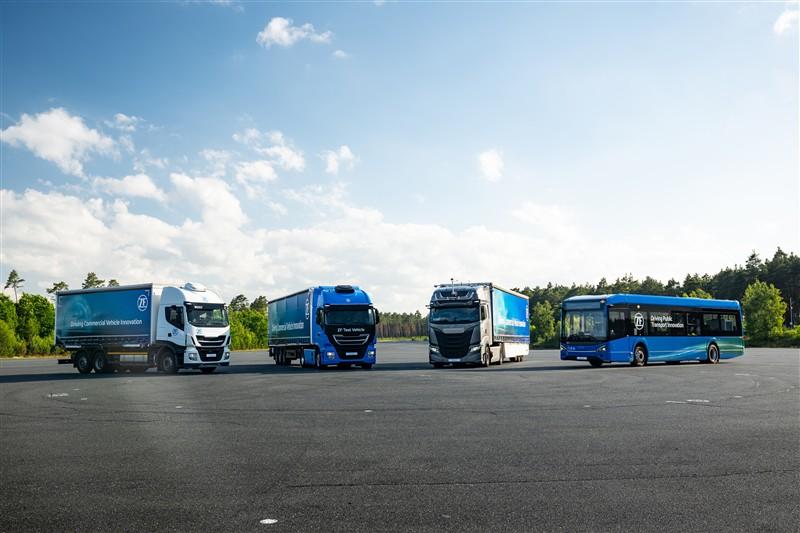
At its test track near Hanover, ZF is demonstrating its latest safety and motion system innovations for trucks and city buses ahead of IAA Transportation 2026. Here, during CV Tech Day 2026, ZF previews how commercial vehicles evolve into software-defined, AI-driven platforms that deliver value today and prepare fleets for future requirements. Because the transition progresses at different speeds in different markets, ZF emphasises maximum flexibility for its customers with scalable architectures, integrated safety systems and modular electrification. This approach improves safety, efficiency and total cost of ownership while protecting existing investments.
Rather than focusing on disruptive change only, ZF follows an evolutionary approach, building on scalable platforms, flexible E/E architectures, system intelligence and digital eco-systems. This allows OEMs and fleets to continuously improve efficiency, safety, uptime, and total cost of ownership across the entire vehicle lifecycle while ensuring a sustainable utilisation of existing investments.
“The direction toward the commercial vehicle of the future is crystalising, but the path is non-linear and iterative,” said Andreas Moser, Member of the ZF Board of Management and Head of Commercial Vehicle Solutions Division. “At CV Tech Day, we demonstrate how we support our customers with practical solutions that deliver value today and enable a cost-efficient, scalable transition toward zero accidents and zero emissions.”
Software-defined vehicle architecture: the next technological step for commercial vehicles
ZF advances towards software-defined architectures that turn vehicles into upgradeable platforms. Purpose-built E/E and software structures enable continuous improvements such as enhanced sensing, predictive maintenance and reduced energy consumption over the vehicle lifecycle. This approach supports OEMs in introducing new functions via software while keeping hardware changes to a minimum.
From isolated functions to scalable 360° safety
ZF combines ADAS, braking and steering into an integrated safety ecosystem that extends across truck and trailer. Radar and camera systems enable continuous 360° perception, eliminating blind spots and supporting functions like reversing assistance, driver monitoring and emergency vehicle detection. This system-level approach creates a clear pathway toward higher levels of automation and the long-term goal of zero accidents.
City buses: safer, more precise, more efficient urban operation
ZF adapts its system approach to the specific requirements of public transport. Solutions like City Bus Assist support precise bus stop approaches and reduce vehicle wear, while dedicated braking strategies improve passenger safety. Systems such as CDC Skyhook continuously adjust damping in real time to enhance stability, ride comfort and operational efficiency in dense urban environments.
Smooth pathways toward decarbonised transport
ZF enables a flexible transition to electrified drivetrains across different applications. The portfolio ranges from hybrid solutions to fully electric driveline systems. This modular approach allows OEMs to electrify existing vehicle architectures step by step, improving efficiency and total cost of ownership.