


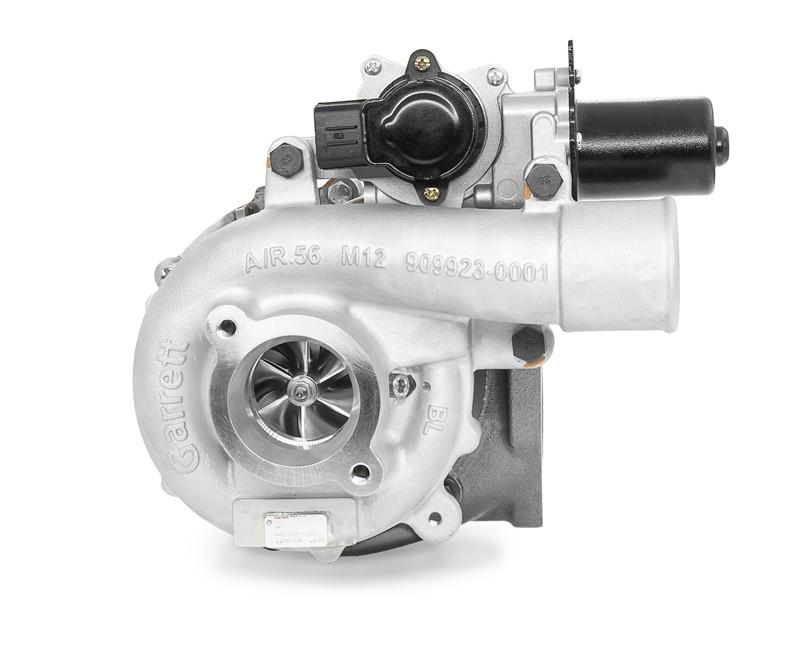
Garrett PowerMax direct-fit turbochargers represent a significant evolution in aftermarket forced induction upgrades, combining Garrett’s long-established engineering pedigree with plug-and-play convenience. Garrett developed the PowerMax range to deliver substantial performance gains without the fabrication challenges of custom turbo installations. These units are engineered to meet or exceed OEM quality standards while offering notable improvements in airflow, power potential and throttle response across a wide range of engines, from diesel 4×4 workhorses to high-revving petrol performance platforms.
A defining attribute of the PowerMax range is its direct-fit design. Unlike bespoke or “big turbo” custom setups that often require manifold modifications, aftermarket piping or intercooler changes, PowerMax turbochargers are engineered to replace the stock turbocharger directly. On vehicles such as the Ford Ranger 3.0L diesel or Mazda BT-50 3.2L Duratorq diesel, these turbochargers use the OE mounting points and connections – ensuring a true bolt-on install with minimal additional parts required.
Performance enhancements stem from Garrett’s application of advanced aerodynamics and modern material sciences. This technological evolution contributes to measurable increases in compressor flow – often in the range of 20 percent or more compared to original equipment turbochargers.
The range’s versatility is another strong point. Garrett offers PowerMax turbochargers tailored to a broad array of vehicles: from Australian diesel like the Toyota LandCruiser 70 and 79 series and Ford Next Gen Ranger 3.0L V6 diesels to petrol-driven performance cars such as Ford Ranger Raptor 3.0L V6 petrol.
Perhaps most appealing to enthusiasts and tuners alike is that PowerMax turbos strike a balance between enhanced performance and ease of installation. By retaining OEM installation specifications – complete with calibrated electronic actuators and ancillary hardware – these turbochargers effectively eliminate much of the guesswork traditionally associated with forced induction upgrades.
Key features of Garrett PowerMax Direct-Fit turbochargers
• Direct-Fit OEM replacement – Designed for bolt-on installation without fabrication, using OEM mounting points and components.
• Increased airflow and power potential – Offers significant increases in compressor and turbine airflow versus stock units, enabling higher power outputs when paired with calibration.
• Advanced compressor and turbine design – Uses fully machined wheels and optimised aerodynamics for improved efficiency and heat tolerance.
• Positive real-world feedback – Many users report smooth power delivery and stronger performance compared to stock turbos, especially after tuning, with straightforward installation praised in community reviews.
• Speed sensor port – All PowerMax turbochargers come with a speed sensor port to allow tuners to tune to the maximum turbine wheel speed to make sure the turbocharger does not go into overspeed past its limits.
Intercooler upgrades
Garrett also recommends that due to increased airflow and pressures of the PowerMax turbocharger, are larger hi-flow enhanced design intercooler also be fitted to allow to maximise the newfound airflow and a reduction in manifold air intake temperature which results in better manifold air density feeding the engine.
Garrett has a range of direct replacement bar-and plate-intercoolers available with also new additions in February 2026 to suit the Ford Next Generation Ranger 3.0L diesel V6 and the Ford Raptor 3.0L V6 petrol with both being a direct bolt in replacement with a 200+ increase in size capacity than the original intercooler.
Bar-and-plate intercoolers are generally more efficient than tube-and-fin designs because they offer greater thermal mass and improved heat transfer. For high-performance and aggressively tuned applications, bar-and-plate intercoolers provide superior durability, consistency, and cooling efficiency.
Why is using a turbocharger speed sensor for tuning is so important?
When tuning a turbocharged vehicle, power gains often steal the spotlight–but precision is what keeps those gains reliable. That’s where a turbo speed sensor becomes essential. Far from being a luxury add-on, it’s a critical tool for anyone serious about safe, effective tuning.
A turbo speed sensor measures how fast the turbocharger shaft is spinning in real time. This matters because boost pressure alone doesn’t tell the full story. Two different turbos can produce the same boost while operating at very different shaft speeds and exceeding a turbo’s maximum safe RPM can lead to catastrophic failure. Without a speed sensor, tuners are effectively guessing.
Using turbo speed data allows tuners to optimise performance while staying within the mechanical limits of the turbocharger. It helps identify compressor surge, overspeed conditions, and inefficiencies that boost-based tuning can’t detect. This is especially important with modern, high-efficiency turbos that can overspeed quickly, particularly during transient conditions or aggressive tuning.
Garrett G-Smart module
Track your turbo’s performance in real-time with the Garrett G-Smart Module. Transmit turbo speed and boost via Bluetooth with the free G-Smart application. This important data will allow users to see if they are operating the turbocharger within its recommended RPM limits to optimise durability and performance.
Features
• Bluetooth operation transmits data from the module to the G-Smart application.
• Modern display with live turbo speed and boost pressure (if connected) readings.
• Gauge sweep will transition colour (G,Y,R) signalling the approach to max-rated turbo speed.
• Marker on gauge sweep indicates peak turbo speed.
• Display up to 120 seconds of turbo speed and boost data in easy-to-view graphical format.
• Compatibility with both Android and iOS devices.
• Easy installation and configuration with pre-set Garrett models and part numbers.
• Create custom configurations for Garrett turbochargers without pre-machined speed sensor port or non-Garrett manufactured turbochargers.
• Min/Max Turbo speed and boost pressure stored in app for future analysis.