


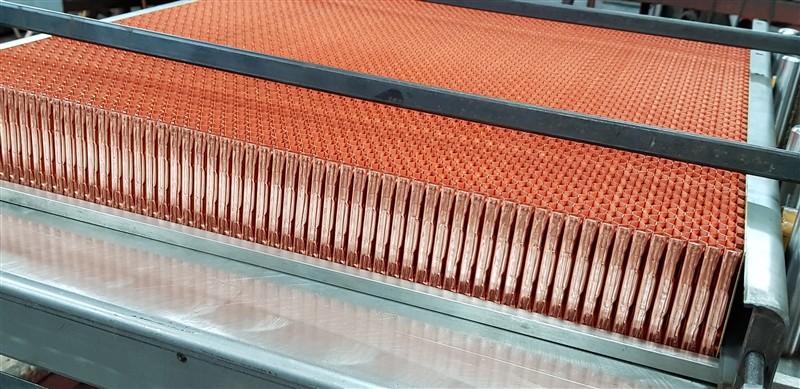
Industrial Radiators are currently still producing authentic honeycomb radiator cores in, Christchurch using original film-type manufacturing equipment that’s been in service for close to a century.
This isn’t reproduction tooling or a modern version of the process. It’s the actual machinery, with a working history that traces back to Johnson Brothers Radiators in Parramatta Road, Ashfield, Sydney. Based on what they’ve been able to gather, the equipment itself dates back to around circa 1930s, possibly earlier.
Johnson Brothers ran this as a proper production set-up. After that, it stayed in use under another owner at the same address for more than 40 years. It never really left service, which is a big reason why it survived.
In 2009, Greg Stevens from Fuel Tank & Repair Services in Australia purchased the machinery. When it was collected, the original timber casting patterns for parts of the press were still there, wrapped and stored. That tells you the setup is generic. It was purpose built for this specific job. Creating the best Honeycomb cores available on the market.
The die sets are imperial, ranging from 2” up to 4”, which lines up with the type of radiator sizes being produced at the time. The press itself has been designed and build around those dies, so everything works as a matched system rather than separate pieces put together later.
Greg spent years restoring the machinery, refining the tooling, and getting the process back to a consistent, working standard.
In 2025, Industrial Radiators purchased the full operation and relocated it to Christchurch New Zealand. Since then, training has been completed and the machinery is now back in full production.
A bit of background on honeycomb radiators
Honeycomb radiators were widely used from the early 1900s through to the late 1930s.
Instead of tubes and fins like modern radiators, these are made up of hundreds of small cells, usually hexagonal that allow air to pass through while coolant flows across the structure. We produce the only cleanable Honeycomb in the world.
Early designs like those developed by Harrison Radiator Company in the 1910s helped make this style common across a wide range of vehicles. They worked well, but they were labour-intensive to produce.
As manufacturing moved toward faster and cheaper methods, honeycomb cores were phased out in favour of tube-and-fin designs. That’s why very few places can still produce them properly today.
How the cores are made
The process they’re running now follows the original method.
1. It starts with copper film supplied in rolls. The material needs to meet specific requirements, thickness, tensile strength, elongation, and hardness because it’s formed and worked multiple times.
2.The copper is fed through the press, where dies stamp the shape into it. These corrugations form the structure that becomes the hexagon pattern once assembled.
From there, the strip is fed forward using a cam system into an indexed guillotine and cut to length.
3. Each strip is then lock-seamed into a tube. That gives it strength and creates the flat faces needed for soldering the tanks.
The tubes are stacked with a fin strip between them, clamped together, and then dipped face-first into molten solder. That bonds everything into a single solid core.
4. For non-square radiators, timber formers are used during assembly to hold the shape. Final adjustments are done by hand after dipping.
Updates to the process
The machinery is original, and a few practical improvements have been made over the years.
The main one is increasing the copper thickness from 0.11 mm to 0.15 mm. That improves durability and service life without changing the way the core performs.
The aim is to keep the construction true to original, but make sure the cores hold up in real use.
Core options
They currently produce the standard 5/16’’ hexagon core, which suits most applications and come in a range of 6 different thicknesses: 2, 2¼, 2½, 2¾, 3, 3½ and 4 inches.
They also have the capability to produce Cellular Film cores. That’s less common, but it does show up in certain American vehicles. Having the correct tooling means those radiators can be built properly instead of approximated.
Their modern 2800 square metre facility is world class, where we build and produce the toughest and most durable radiators in New Zealand, from Vintage to Mining cooling units. They cover them all.
Where it sits now
There aren’t many places left that can produce true honeycomb cores using original equipment and process.
This setup has stayed in use from Johnson Brothers, through decades of operation in Sydney, through Greg Stevens restoring it, and now with Industrial Radiators running it in Christchurch.
It hasn’t been recreated. It’s been carried through.
They’re just continuing the process the way it was originally done, with a few improvements to make sure it lasts.
That’s what matters for proper restorations.