



Upper Hutt company Hoist has spent six months proving its cloud-based software in working New Zealand workshops. It is now moving into its next phase: a mobile app for technicians, and AI tools to cut down on admin and give owners clear business analytics.
Hoist was built with a simple goal: free up admin time so workshop owners can get on with what actually matters.
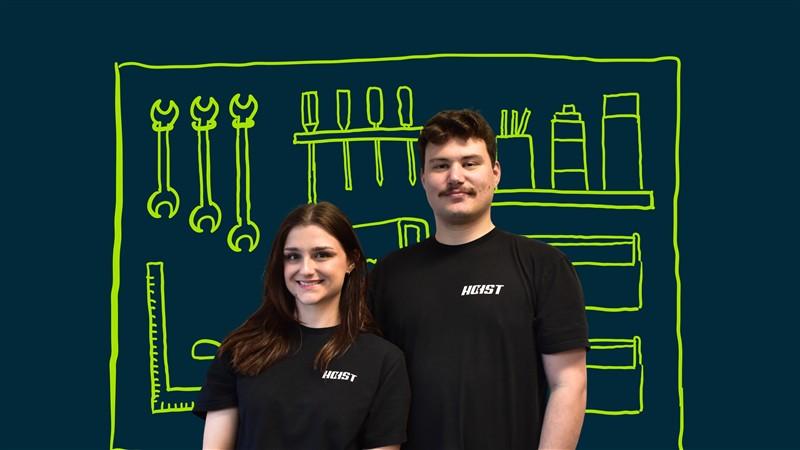
Hoist was founded by chief executive Jess Ross and chief technology officer Alex Snyman, and the company’s connection to the trade started small. A shared love of off-roading and software led to a side hustle hosting websites for mates in the automotive trade, and through those mates the same frustration kept coming up: running a workshop shouldn’t be this hard. So Snyman, an engineer with a background in the medical and defence sectors, started building. What began with mates soon reached strangers with the same problem. That’s when it started to feel like something real.
Getting the fundamentals right came first – a one-stop platform intuitive enough for any technician to pick up, yet robust enough to run a workshop end to end. Its New Zealand-specific features are typically what workshops notice first: registration lookups that return WoF and CoF expiry dates, native GST handling, and integrations with Xero, CarJam, and Eftpos payment terminals.
“Finding our top customers used to mean digging through records one by one – now it’s just there on our dashboard. WoF reminders were the same story: we had to remember to send them every week ourselves. Now they either go out automatically or pop up in our actions, so we send them when it actually suits us,” says Amy Gray, Director at Gray Mechanical in Hokitika.
“Before Hoist, we were trying to make a general trade system fit an automotive tyre business. Now we’ve got quoting, jobs, invoicing, inventory, and vehicle tracking all working together in one place. It’s streamlined the business, made things much easier as we’ve grown, and reduced the little admin mistakes that come from double-handling information,” says Rachael Keen, Office Manager at Keen As Tyres in Timaru.
With that foundation proven, Hoist is now building outward on two fronts at once.
The first is mobile. Currently in beta with a group of workshops, Hoist’s new app is designed to put the platform in technicians’ hands wherever the work happens, on the shop floor or out on the road. Technicians will be able to open the day’s job, log time, add notes and photos, scan invoices, and mark work complete from a phone or tablet, with the office seeing each update as it happens.
The second is data. “Workshops generate a huge amount of data every day, and most of it just sits there,” says Snyman. “We want Hoist to actually put that data to work – helping owners spot opportunities they’d otherwise miss, and make calls with more confidence.”
Hoist is developing automation and intelligence to give workshops real value, from custom reporting and business analytics to tailored job suggestions, travel calculators, and scanning tools that read and process invoices and purchase orders automatically. Together, the aim is to help workshops win higher-value jobs, cut down manual admin, and make faster, better-informed decisions.
“Our approach is simple: no tiers, no upsells, just one plan with every native feature included,” says Ross. “It’s a straightforward, Kiwi way of doing things.” Updates ship weekly based on customer requests, and support is local, at no extra cost.
Workshops can trial the full platform free for 14 days, no card required, at hoist.nz
NZ workshop software Hoist goes mobile and starts doing the admin itself
NZ workshop software Hoist goes mobile and starts doing the admin itself
Technology
Friday, 30 October 2026
Related Articles

Friday, 30 October 2026
With nearly 1.8 million public charging points built worldwide in 2025, the global total now nears 7 million, but the pace of infrastructure rollout varies dramatically from country to country.
To...
Thursday, 29 October 2026
Developed by Bosch in 1976 and first installed in production vehicles by Volvo that same year, the lambda sensor marked a technical revolution in the automotive industry. Today, it has become an...

Friday, 02 October 2026
Ever since it premiered the servo brake in 1927, Bosch has been continuously tweaking the way brakes work.